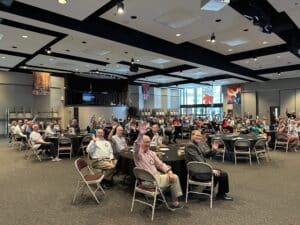
The Lakeland Rotary Club was founded February 15, 1918, the sixth club in the state of Florida.
For more than 100 years, this club has served its community and others throughout the world in need; growing to
its current membership of more than 170, one of the largest in the state.
The Lakeland Rotary Club is a club with a proud tradition and a continuing commitment to “Service above Self”.
Aside from weekly meetings, we perform service projects in Lakeland, enjoy social meet ups for fellowship and fun, and participate in projects impacting lives in other parts of the world.
Past Club Accomplishments
Local Projects:
• Providing AEDs for every police car in the Lakeland Police Department
• Swimming lessons for kids
• Cleaning Lake Wire and Veterans’ Park
• Packing meals at KidsPack
• Delivering meals for VISTE
• Ring the Bell for the Salvation Army in December
• Scholarships to local high school seniors
Fundraisers:
• Golf Championship to raise money for Flight to Honor
• Spring Obsession raises money to help schools
• Rotary Twilight 5K for Common Ground Park maintenance
• Know and Grow to provide laptops to students
International Projects:
• Disaster Relief for several hurricanes
• Disaster Relief in Ukraine: helped purchase ambulances, medical supplies, and generators for hospitals
• Upgrade of Health Centers in Pune City, India
• Human Milk Bank in Brazil
• Water and Sanitation for Yarumela, Honduras
• Mission Trips to La Paz Honduras to build houses and pilas, install latrines and water filters, feed communities
Fellowship & Fun:
• Basketball game vs Kiwanians
• Bourbon Tasting
• Deep Sea Fishing
• Bowling
• Trivia
Dr. Henry D. McIntosh was a highly respected American cardiologist, educator, and humanitarian best known for founding what became ForHearts Worldwide (originally called Heartbeat International Worldwide) in 1984. He served as president of the American College of Cardiology in 1974–75 and held leadership positions at institutions including Baylor College of Medicine, Duke University School of Medicine, and the University of Florida College of Medicine.
The inspiration for the organization came from a tragedy in Guatemala. A Guatemalan physician, Federico Alfaro, treated a teenage boy suffering from complete heart block — a condition that could have been corrected with a pacemaker. Because the boy’s family could not afford the device, he died. Dr. Alfaro later contacted his former mentor, Dr. McIntosh, seeking help to prevent similar deaths in poor countries.
Dr. McIntosh responded with the idea of collecting and donating pacemakers to indigent patients abroad. Around 1982, he invited Dr. Alfaro to a cardiology conference in the United States and presented him with six donated pacemakers intended for Guatemalan patients. A member of Rotary International attending the conference recognized the humanitarian potential of the idea and helped connect the project with pacemaker manufacturer Intermedics, Inc. Rotary International later provided major grant funding — reported at approximately $250,000 — helping transform the small effort into an organized international medical mission.
On October 18, 1984, Dr. McIntosh formally launched Heartbeat International Worldwide from Watson Clinic in Lakeland, where he practiced medicine. The organization operated through partnerships among Rotary clubs, physicians, hospitals, and pacemaker manufacturers. Rotary chapters around the world helped establish “pacemaker banks” that distributed donated cardiac devices to poor patients in developing nations.
The mission expanded rapidly. Within about 16 months, pacemaker banks had been established in 16 countries. Over time, the organization provided thousands of life-saving pacemakers and implantable cardiac devices across Latin America, Africa, Asia, and other underserved regions. The program also trained local physicians in cardiac pacing and follow-up care.
Dr. McIntosh retired from active leadership in 1986, and Benedict S. Maniscalco later expanded the organization’s reach. In 2022, the charity rebranded as ForHearts Worldwide to reflect broader cardiovascular services beyond pacemaker implantation.
One of Dr. McIntosh’s guiding principles was:
“The service we give to our fellow man is the rent we pay for the right to live.”
That philosophy became central to the partnership between physicians and Rotary volunteers that helped build the humanitarian heart-care network.